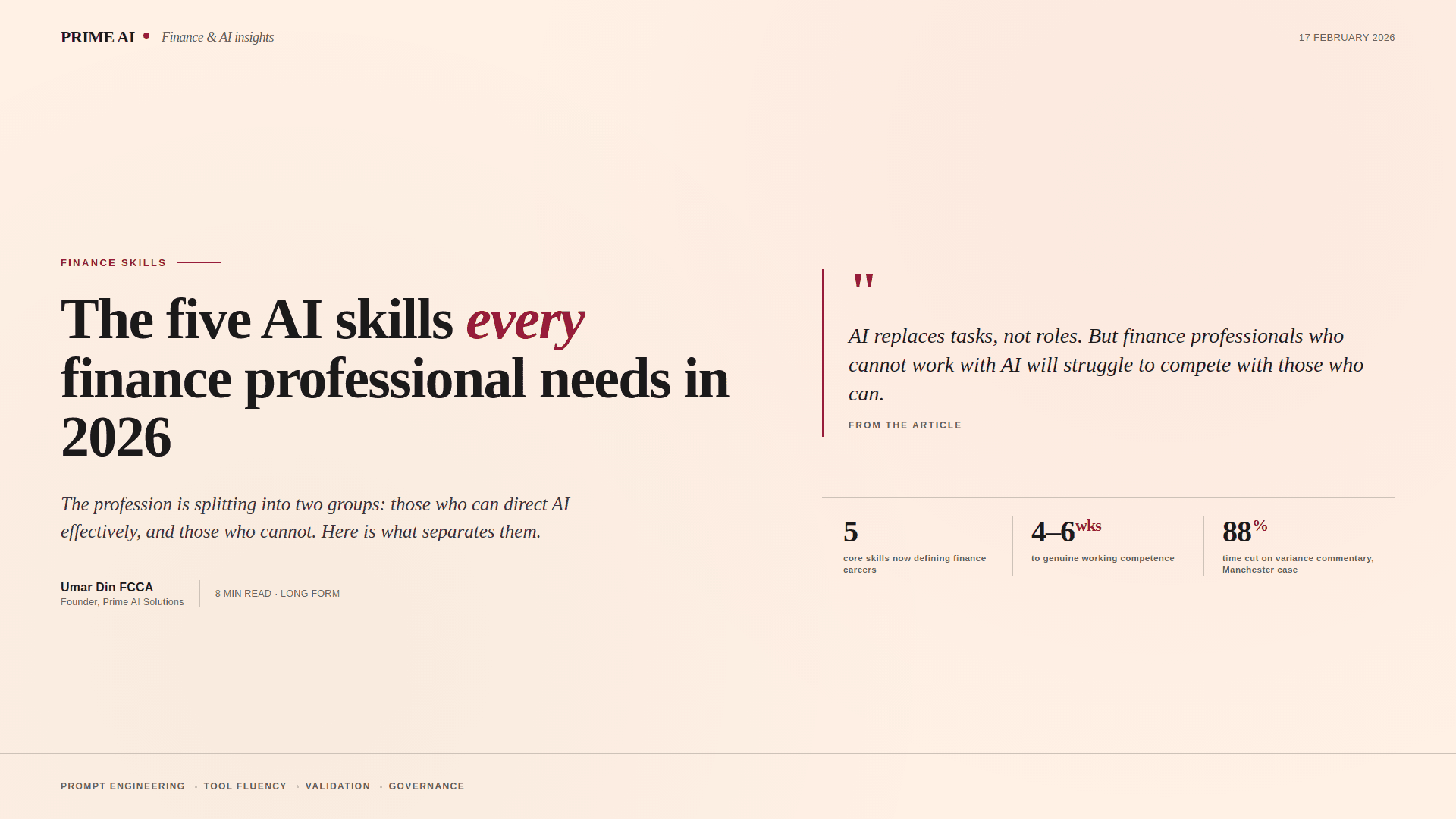
The finance profession is splitting into two groups. Those who know how to use AI effectively, who can direct AI tools, validate their outputs, and integrate them into real workflows, are seeing their productivity and career opportunities expand. Those who have not yet developed these skills are finding their roles increasingly pressured by colleagues and competitors who have.
This split is not about who will be replaced by AI. The evidence on AI replacing finance professionals is clear: AI replaces tasks, not roles. But finance professionals who cannot work with AI tools will increasingly struggle to compete with those who can. The five skills covered in this article are the ones that matter most, drawn from finance teams I have worked with across UK and MENA practice and industry, including former colleagues at EY and HSBC. For the broader picture on AI use cases across finance functions, see our complete AI use cases in finance guide.
The five skills, in one sentence each
- Prompt engineering: structure your instructions so the AI produces finance-grade output, not generic prose.
- AI tool fluency: know which tool to use for which task, and the boundaries of each.
- Data literacy and output validation: read AI output critically, catch errors, never paste unvalidated numbers into a board pack.
- Governance and ethics awareness: understand what data goes where, and when to escalate.
- How to build the above: structured learning beats experimentation, especially under regulatory or audit scrutiny.
The Skills Gap Is Real
Despite the rapid spread of AI tools across the workplace, most finance teams have not had structured training on how to use them effectively. Individual team members have experimented - often using ChatGPT for drafting or Copilot for data analysis - but without guidance on best practices, data governance, or output validation, results have been inconsistent.
This inconsistency is self-defeating. When AI tools produce unreliable results - usually because of poorly structured prompts or incorrect assumptions about what the tool can do - finance professionals conclude that AI is not reliable enough for finance use. They revert to manual processes and fall further behind colleagues who have invested in developing their AI skills properly.
The skills gap is particularly pronounced in three areas: prompt engineering (most finance professionals have never been taught how to write effective prompts), output validation (knowing when to trust AI results and when to scrutinise them), and governance awareness (understanding which AI uses are appropriate with which data). These are addressable gaps - they do not require technical backgrounds - but they do require structured learning.
Prompt Engineering for Finance
Prompt engineering is the single most impactful AI skill for finance professionals. The quality of what you get from AI tools is almost entirely determined by the quality of the instructions you give them. A well-structured prompt produces finance-quality variance analysis, regulatory-appropriate narrative, and accurate calculations. A vague prompt produces generic, often unreliable output that takes as long to correct as it would have taken to write manually.
The RACEF framework for finance prompting provides a structured approach. RACEF stands for Role, Action, Context, Examples, and Format. Each element of the framework adds precision to the prompt: defining the role tells the AI what expertise to draw on, providing context gives it the specific numbers and conditions to work with, including examples shows it the quality and style of output required, and specifying format ensures the output is immediately usable rather than requiring restructuring.
The RACEF framework, set out as a reference table:
| Element | What to specify | Finance example |
|---|---|---|
| Role | The expertise the AI should draw on. | “You are a senior finance business partner preparing board commentary for a UK mid-market business.” |
| Action | The specific task in one sentence. | “Explain why payroll cost is £47k unfavourable against budget for March.” |
| Context | The numbers, period, and surrounding business facts. | Actual vs budget by entity, headcount additions in-period, any reorganisation or one-off items. |
| Examples | A prior commentary that demonstrates the required style and depth. | A redacted variance commentary from last quarter the board signed off on. |
| Format | The output structure required. | “Two paragraphs, no more than 120 words. Lead with the cause, follow with mitigation.” |
Before and after, a worked example. Same dataset, two prompts, two very different outputs.
Poorly structured prompt
“Analyse this variance.”
Output:
“The variance shows a difference between actual and budget. There could be several reasons for this difference. You may want to investigate further to understand the underlying causes.”
Useless. Generic. Will be re-written from scratch.
RACEF-structured prompt
[full RACEF prompt as in the table above]
Output:
“Payroll is £47k unfavourable to budget in March, driven by three early hires in the Edinburgh team brought forward from Q2 to support the new compliance workstream. The full-month cost of these roles was not modelled until April. Run-rate normalises in line with budget from May once attrition assumed in plan also lands.”
Specific. Quantified. Board-ready first draft.
The difference in output quality is substantial. Finance professionals who invest in learning prompt engineering consistently describe it as the highest-return skill development they have done in recent years. It takes 4-6 hours of focused practice to develop basic competence and several weeks of regular use to become genuinely proficient.
Want to go deeper? Our AI for Finance Leaders course covers this in detail with practical templates and exercises.
AI Tool Fluency
AI tool fluency means knowing which tool to use for which task - and understanding the meaningful differences between them. This matters because ChatGPT, Microsoft Copilot, and Claude are not interchangeable. They have different strengths, different data access models, different privacy considerations, and different performance profiles on finance-specific tasks.
Our guide to ChatGPT vs Copilot vs Claude for finance covers this comparison in depth. The short version: Copilot for Microsoft 365 is the strongest choice for tasks involving your own data (Excel analysis, Outlook drafting, Teams summarisation) because it operates within your organisation's security boundary. ChatGPT is highly effective for general financial analysis, document drafting, and formula generation where you are not sharing sensitive internal data. Claude performs particularly well on long-document tasks - reading and summarising lengthy reports, contracts, or regulatory documents.
For financial research specifically - competitor monitoring, market analysis, company diligence preparation - Perplexity is the specialist tool. Unlike ChatGPT or Claude, Perplexity retrieves live web sources and cites them, making it more reliable for tasks where you need current market data or external context rather than analysis of documents you have already provided.
Tool fluency also means knowing when not to use AI. Some finance tasks are not well-suited to current AI tools - tasks requiring precise numerical calculations on complex multi-step logic, tasks involving data that cannot leave your environment, or tasks where the cost of an error is too high to accept AI-level risk. Knowing these boundaries is as important as knowing where AI adds value.
Developing tool fluency requires hands-on experimentation across multiple tools. The best approach is to take a recurring finance task you understand well - a variance commentary, a reconciliation, a data analysis - and run it through two or three different AI tools to compare outputs. This systematic experimentation builds genuine understanding of what each tool does well, much faster than reading about it.
Data Literacy and AI Output Validation
AI makes errors. Sometimes they are obvious; often they are plausible-sounding but incorrect. Finance professionals who cannot recognise AI errors are dangerous - they will publish incorrect figures, make wrong decisions, and potentially expose their organisation to regulatory or reputational risk.
Data literacy in the AI context means having the skills to evaluate AI outputs critically. This includes: checking numerical outputs against source data and common-sense benchmarks, identifying when AI has made incorrect assumptions about the data it was given, recognising hallucinated figures (numbers the AI invented rather than calculated), and knowing when to request a different approach or use a different tool.
Practical validation habits for finance professionals. Always verify material numbers against source data before using them. When AI generates a calculation, check the logic independently for the first several uses until you have calibrated how reliable the tool is for that type of task. For narrative outputs, verify that every factual claim in the AI-generated text is supported by the data you provided. Treat AI output as a first draft that requires review, not a final product.
As AI tools improve, the validation burden reduces, but it does not disappear. The appropriate level of scrutiny depends on materiality (how significant is the output if it is wrong?), novelty (is this a task you have validated before?), and complexity (how many steps did the AI perform?). Developing a systematic approach to these three questions is the foundation of effective AI output validation.
Common mistake: trusting confident-sounding output
The most expensive errors I have seen in finance teams using AI come from reviewers approving plausible-sounding text without checking the underlying figures. AI tools produce confident prose even when working from incorrect or partial data. A board commentary that reads beautifully but cites an inaccurate variance is materially worse than a clumsy commentary citing the right number. Treat tone and confidence as no signal at all when validating AI output, only the numbers and the source.
Governance and Ethics Awareness
Governance awareness is an underappreciated AI skill, but it is rapidly becoming essential. Finance professionals need to understand which AI uses are appropriate with which data - not just for compliance reasons, but because failure to follow appropriate data practices creates material risk for their organisations and for their careers.
The key governance questions every finance professional should be able to answer: Can I paste this data into a public AI tool? (Usually: not if it contains personally identifiable information, material non-public financial data, or data subject to contractual confidentiality.) Does my organisation have a policy on AI tool use? (If yes, follow it. If no, assume conservative defaults and advocate for a policy.) What should I do if I suspect an AI output contains an error that has already been used in a decision? (Report it, correct it, document it.)
Our AI governance framework for finance provides the policy foundation that finance professionals should be working within. Understanding this framework, even if you did not write it, makes you a more responsible and effective AI user.
Professional standards anchor
The professional bodies have started codifying this. The ACCA Code of Ethics and Conduct requires members to act with professional competence and due care, which extends to the tools they use; using an AI tool to produce work you do not understand or cannot validate breaches that duty. ISO/IEC 42001:2023 is the international standard for AI management systems, increasingly referenced in tenders and audit committees. IFAC's Technology Initiative guidance specifically addresses professional accountants' responsibilities when adopting AI in financial reporting and assurance.
How to Build These Skills
There are three realistic paths to building AI skills as a finance professional: self-directed learning, employer-provided training, or structured courses. Each has its place, and the right approach depends on your timeline, learning style, and the depth of skill you need.
Self-directed learning is accessible and free, but slow and inconsistent. Reading articles, watching tutorials, and experimenting with tools will build some capability, but without structure it is easy to miss important skills and develop bad habits - particularly around prompt engineering and output validation.
Employer-provided training is the most efficient path when available. If your organisation is investing in AI tools, push for structured training as part of that investment. Generic AI training is less useful than finance-specific training - make the case for training that covers your actual workflows.
Structured courses are the fastest path to genuine competence. The AI for Finance Leaders course builds all five skills, prompt engineering, tool fluency, data literacy, output validation, and governance awareness, systematically across 59 structured lessons. Every module uses finance-specific examples and exercises, so the learning transfers directly to your work. No coding background is required. Most participants complete the course in 4-6 weeks alongside their normal workload and report immediate improvements in their day-to-day AI use.
CPD relevance
For ACCA, CIMA, and ICAEW members, AI competency development is increasingly recognised as relevant continuing professional development. IES 6 (Initial Professional Development) and IES 7 (Continuing Professional Development) from the International Accounting Education Standards Board both reference adapting to technological change as a core requirement. Time spent on structured AI skill development can typically be claimed as CPD under output-based or input-based reporting depending on your professional body. Check with your specific body for verifiable evidence requirements.
From the field: a Manchester finance team
A mid-market manufacturer with a six-entity finance function adopted these five skills systematically over a quarter. The Finance Director and two senior team members completed the structured course; the rest of the team learned via internal sessions led by them. Within twelve weeks they had reduced monthly variance commentary drafting from three hours per entity to twenty-five minutes, and the Finance Director reported board pack quality improved measurably because the team was spending the saved time on judgement and review rather than first drafts. The skills compounded: the same team has since extended their Claude Projects setup to cash flow forecasting and customer concentration analysis without needing further outside support.
Next steps with Prime AI Solutions
AI Readiness Check
5 questions, instant score. See where AI actually fits in your business before committing to anything.
Take the checkAI Opportunity Blueprint
We map your workflows, identify the highest-ROI AI opportunities, and deliver a prioritised roadmap. £10,000+ in annualised savings found in 14 days, or you don't pay.
See the BlueprintAI Consulting
We design and build the workflow, configure the tools, and train your team. Typical engagement runs 8-12 weeks with guaranteed ROI.
Learn moreAI for Finance Leaders Course
6 modules covering FP&A, reporting, automation, and governance. Self-paced, no coding required.
View course